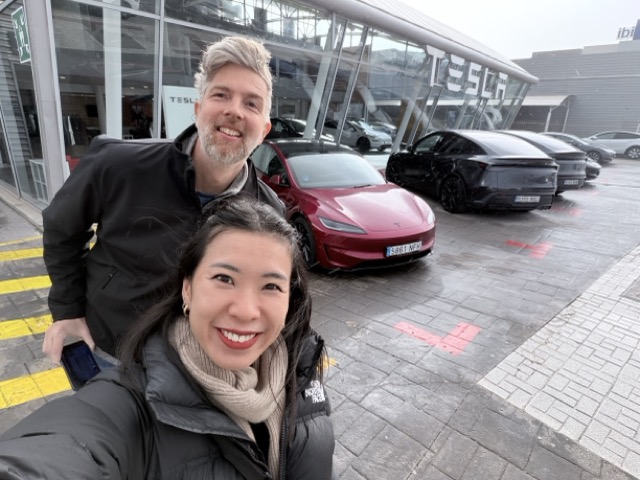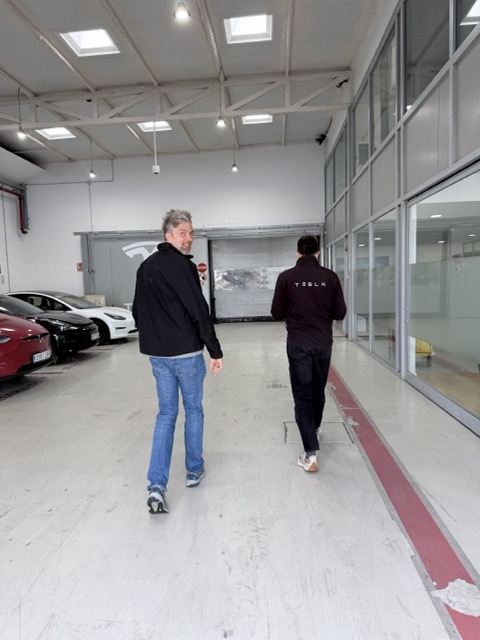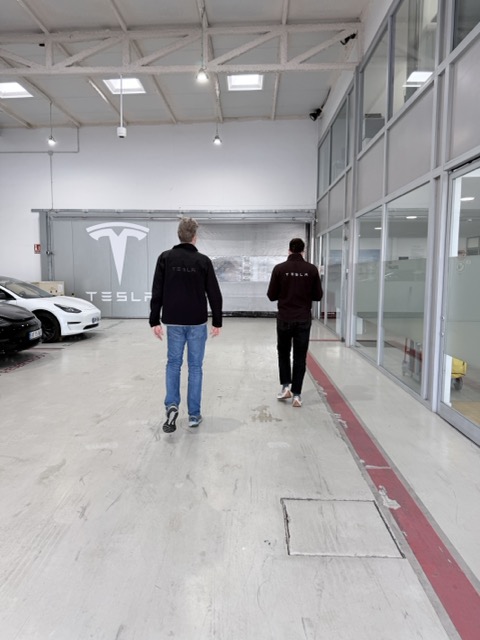
Picture this: We are standing in the shiny Tesla Center in Málaga, Spain, staring at a sleek Model 3 Performance like it’s about to whisk us away on a magic carpet ride. Except this carpet has eight cameras, zero lidar, and a brain trained on more driving miles than we have walked in our entire lives. We hopped in, punched in a destination, engaged Full Self-Driving (Supervised) version 14.1.7 (yes, not even the latest 14.2.4—because why not live dangerously with slightly vintage software?), and off we went.
For a glorious, full hour, we drove around the chaotic, sun-soaked streets of Málaga… without actually driving. Hands off the wheel, feet off the pedals, pure passenger mode. We were basically chauffeured by an AI that thinks it’s human but is suspiciously better at parallel parking and not getting lost in one-way streets.
And let me tell you, Málaga is not an easy playground for self-driving tech. This city throws everything at you:
- Complex two-lane roundabouts where cars merge like they’re auditioning for a demolition derby
- Unprotected left turns across oncoming traffic (the kind where you pray to the traffic gods)
- Double-parked delivery vans blocking half the lane like they own the place
- Stop signs that Spaniards treat as polite suggestions
- Construction zones with temporary lanes narrower than my patience
- Bus lanes that tempt you like forbidden fruit
The car handled it all flawlessly. No interventions, no dramatic beeps, no “take over now!” panic moments. It glided through like a local who’s lived there for 50 years and knows exactly when the baker puts out fresh churros.
Quick aside: watch the 3× speed drive in the video below—chaos in fast-forward glory. It’s like watching a video game where the AI is on god mode.
The smoothness? Chef’s kiss. No jerking, no robotic hesitation—just buttery, confident moves. You can literally feel the billions of human-driven miles baked into this neural net. It’s trained on more bad drivers than we’ve encountered in rush hour, and somehow it turned that chaos into zen.
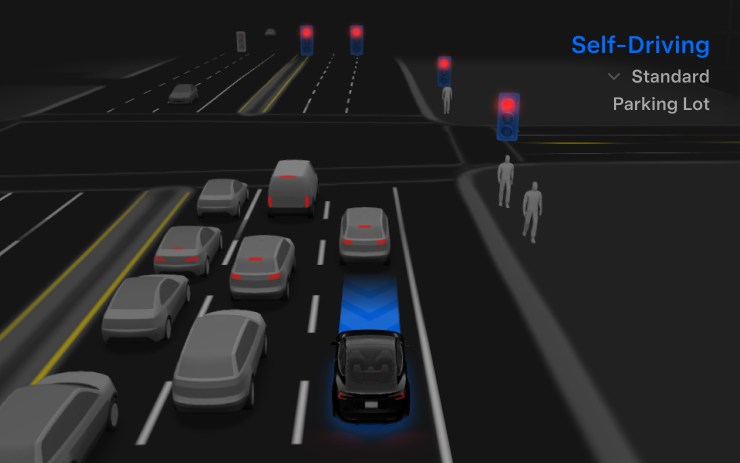
The real magic moments? When the car “sees” things before my human eyeballs even register them. Case in point: a pedestrian suddenly popping out from behind a parked truck, sprinting toward the road on a red light. The Tesla slammed on the brakes instantly—smoothly, no drama—while I was still processing “wait, is that a person?” No one behind us, no honking symphony. Just pure, predictive wizardry. I swear the AI whispered, “I got this, human. Sip your cortado.”
We’ve already ordered our own Tesla Model Y Long Range with the Full Self-Driving package (a cool €7,500 upgrade—worth every cent if it means I can finally eat tapas without one hand on the wheel). But let’s be real: even this impressive 14.1.7 version isn’t ready for true unsupervised city roaming just yet. It’s supervised for a reason—Europe’s roads are spicy.
The good news? The UNECE (the folks who make the global car rules) has basically rolled out the red carpet. They’ve drafted regulations paving the way for wide approval of Tesla’s FSD Supervised (and eventually unsupervised) systems across Europe, Japan, and beyond. The draft heads to the big vote at the World Forum (WP.29) session from June 23–26, 2026. If it passes (and signs point to yes), Tesla could flip the switch for owners almost immediately.
Key takeaways from our Málaga adventure
Pure vision, no crutches: Tesla basically cracked self-driving with just eight cameras. No lidar, no radar crutches like the competition uses. It’s like the car has superhuman eyes and no ego about needing fancy sensors.
Smooth and human-like: The drive feels insanely smooth. No robotic vibes—just confident, chill AI that’s been binge-watching the best (and worst) drivers on Earth.
Predictive wizardry: The system anticipates dangers like a psychic co-pilot. It sees pedestrians, cyclists, and rogue scooters before you do. It’s spooky in the best way.
We can’t wait for this software to land on our Model Y—hopefully by mid-2026. Imagine road-tripping across Europe with the AI handling the stressful bits: narrow Alpine passes, Italian roundabouts that defy geometry, French toll booths with zero patience. We’ll be safer, more relaxed, and probably eating way more croissants instead of white-knuckling the wheel.
Until then, I’m practicing my best “passenger prince” pose. Hands in the air, no fear—because the future is electric, camera-powered, and apparently better at driving in Málaga than most locals.