Solution architecture
Eclipse Vorto, from model to platform
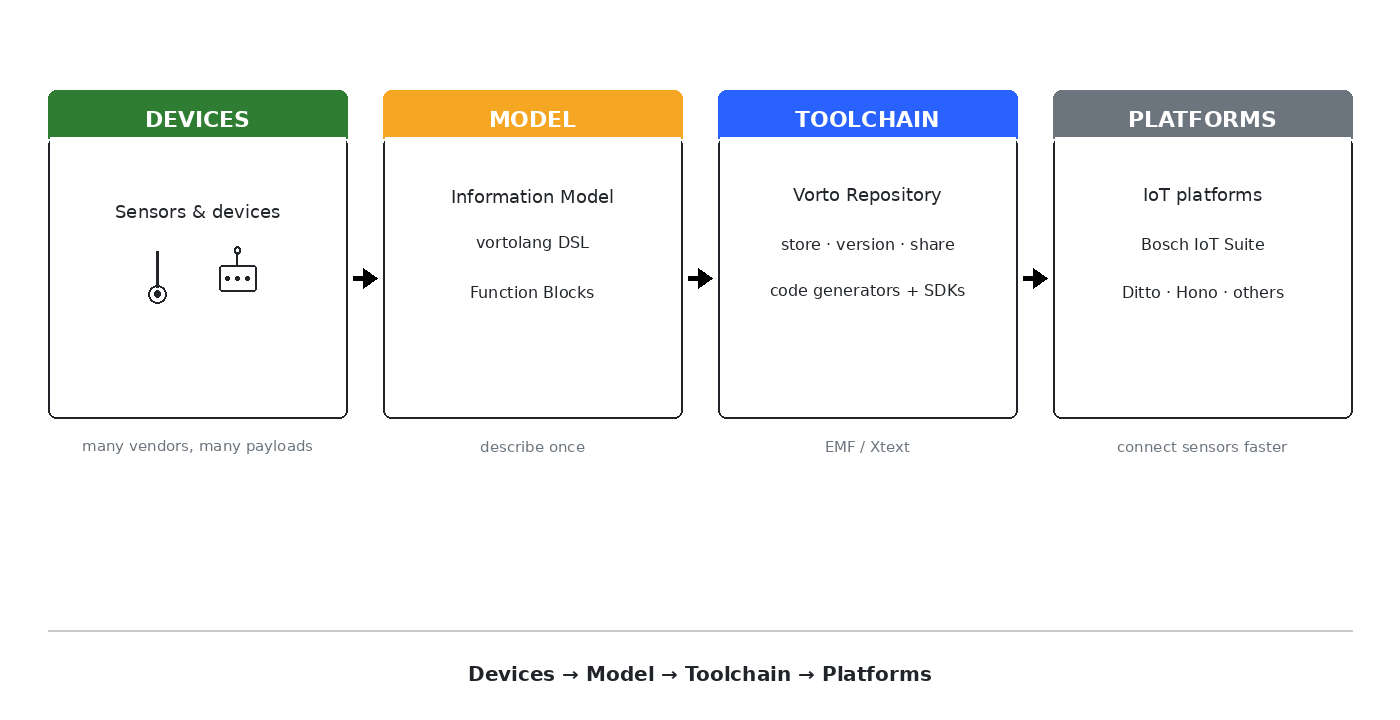
The picture below is the shape of the toolchain. Devices → model → repository → platforms.
The problem
IoT platforms used to bind to a small set of device APIs. Change the sensor or the manufacturer, and the integration had to be rewritten. Vorto’s job was the abstraction in the middle: one information model, many platforms.
Model
Devices were described in vortolang, a DSL meant to be readable. An Information Model is the whole device (the digital twin). Function Blocks are the reusable capabilities—status and configuration properties, events, operations—plus shared datatypes. The metamodel sat on Eclipse EMF; the editors used Eclipse Xtext (Eclipse IDE and a web editor). Describe a temperature sensor once; reuse that function block on the next device.
Toolchain
Four parts, on purpose:
- Language — vortolang
- Metamodel — how information models, function blocks, and datatypes relate
- Repository — store, version, and share models (namespaces, web UI) so a platform team is not keeping private copies
- Generators — turn a model into integration code / SDKs for a specific platform
The stack was Java. Generators shipped for Bosch IoT Suite, Eclipse Ditto, Eclipse Hono, and OpenAPI, plus a plugin SDK so a platform could add its own. A mapping engine sat beside that: arbitrary device payloads onto the function-block shape, so the platform did not have to speak every vendor encoding.
Platforms
This is the work I did as solution architect: help platform providers—Bosch and others—actually plug the toolchain in, so connecting a new sensor was a model plus a generator, not a rewrite. That also includes the smart-building sensor-abstraction work with Google, Microsoft, and others. No protocol walkthroughs and no customer names beyond that.
That is Vorto in one pass: describe the sensor, share the model, generate the integration, connect it to a platform. Public repo: github.com/eclipse/vorto.