Solution architecture
Lift Manager, from shaft to cloud
The picture below is the shape of the system. Hardware → gateway → cloud → people.
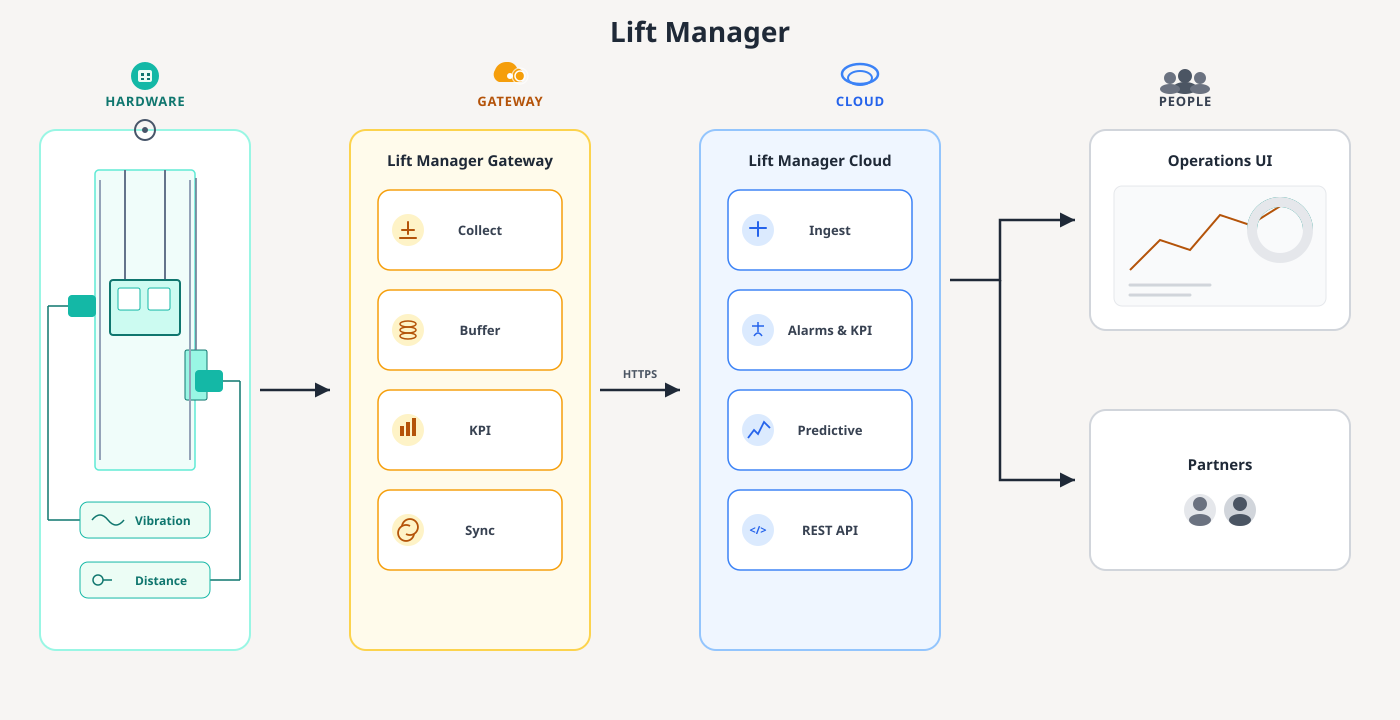
Hardware
Real lifts, not a lab demo. On-shaft sensors collected vibration (accelerometer / CISS) and laser distance at the car and shaft. That stream is what the rest of the stack was built around.
Gateway
The Lift Manager Gateway ran on Java 8 / OSGi with Bosch IoT Gateway Software. Bundles formed a clear pipeline:
- Collect — sensor auto-discovery, CISS, laser distance
- Buffer — raw-data bus / event loop, then clean, persist, and hold locally so a bad uplink does not drop the stream
- KPI — metrics computed on the edge
- Sync — HTTPS up to the cloud
Around that: provisioning, diagnostics, a CLI, and simulators. We shipped images for Windows, macOS, and Raspberry Pi—useful when you are commissioning in a shaft, not only in a data centre.
Cloud
Lift Manager Cloud was Java / Spring Boot on Azure. Event Hubs for ingest, raw files in Data Lake / Blob, MongoDB for operational state. Domain services covered device management, state and topology, alarms, KPIs, anomaly, predictive, reporting, and batch jobs.
The API was REST on purpose. The operations UI lived in a separate Connected Building app; the cloud stayed a service layer, not a monolith that also owned every screen. Day-to-day Azure ops tooling was in the mix—no need to catalogue every product here.
Partners
On the right-hand side of the diagram: people who actually use the data.
- Operations UI — lift conditions for the teams watching the fleet
- Partners — high-level integration with a certification / inspection partner (TÜV SÜD) for anomaly detection
No protocol walkthroughs, no customer names beyond that. The point was a clean cloud surface so operations and partners could see what mattered without living inside the gateway.
That is Lift Manager in one pass: sensors in the shaft, a buffering edge gateway, a REST cloud with predictive and alarm services, and UIs for ops and partners.